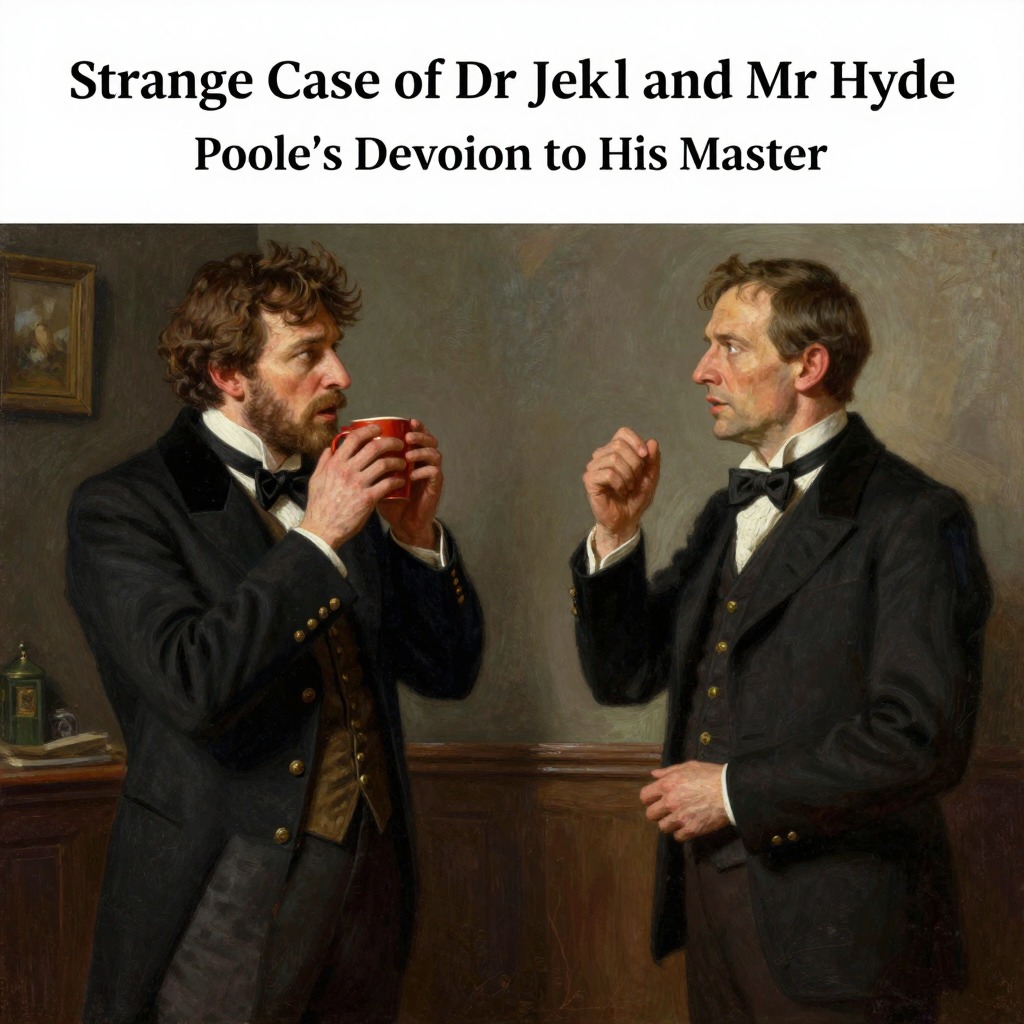
Poole–Jekyll relationship
The Poole–Jekyll relationship is the longest-running domestic tie in the novel, a bond of twenty years' daily service that makes Poole the most intimate observer of Jekyll's physical and psychological collapse. Where Utterson and Lanyon are friends kept at a distance by Jekyll's secrecy, Poole lives in the house, sees his master every morning, and knows the exact height of Jekyll's head against the cabinet door. This accumulated knowledge gives his testimony a weight that no other character's possesses, and it is Poole who finally shatters Utterson's cautious rationalizations and drives the forcible entry into the cabinet.
Identity and Daily Service
Poole is the butler of Dr. Jekyll's house in the square, a well-dressed, elderly servant who admits visitors and manages the household. He has served Jekyll for twenty years, a span that has made him intimately familiar with his master's habits, voice, and physical proportions. When Utterson first visits, Poole admits him into a large, low-roofed hall paved with flags, warmed by a bright open fire and furnished with costly oak cabinets—a room Utterson calls the pleasantest in London. Poole knows that Mr. Hyde has a key to the laboratory door and that the household has orders to obey Hyde. He reports that Hyde never dines in the house and mostly comes and goes by the laboratory, so that the servants see very little of him on the residential side. This arrangement, established by Jekyll's own instructions, places Poole in a position of enforced compliance with a figure he instinctively distrusts.
The Growing Terror and the Appeal to Utterson
As Jekyll's seclusion deepens, Poole becomes the first to sense that something is fundamentally wrong. He appears at Utterson's fireside one evening, his manner altered for the worse, unable to look the lawyer in the face, and sitting with a glass of wine untasted on his knee. He declares that he has been afraid for about a week and can bear it no more. When Utterson asks what ails him, Poole answers hoarsely that he thinks there has been foul play. He refuses to say more but insists that Utterson come and see for himself. The butler's terror is so palpable that Utterson, despite his own misgivings, immediately rises to follow. On the way, Poole keeps a pace or two ahead, and in the middle of the pavement, in spite of the biting March wind, he takes off his hat and mops his brow with a red pocket-handkerchief—not the dews of exertion but the moisture of strangling anguish, his face white and his voice harsh and broken.
The Evidence of the Voice and the Masked Figure
At the house, Poole leads Utterson through the surgical theatre to the foot of the stair, motioning him to stand aside and listen. He knocks on the red baize of the cabinet door and calls out that Mr. Utterson is asking to see the doctor. A voice answers complainingly, "Tell him I cannot see anyone." Poole then turns to Utterson with a note of triumph and asks directly: "Was that my master's voice?" When Utterson admits it seems much changed, Poole declares that he has been twenty years in this man's house and cannot be deceived about his voice. He states flatly that Jekyll was made away with eight days ago, when they heard him cry out upon the name of God, and that something else is now in the cabinet. To Utterson's rationalizing—that Jekyll may be suffering from a deforming malady—Poole responds with a mottled pallor: "that thing was not my master." He points out that Jekyll is a tall, fine build of a man, while the masked figure he saw was more of a dwarf. He describes how he came suddenly into the theatre from the garden, saw the figure at the far end digging among the crates, and watched it give a kind of cry and whip upstairs into the cabinet. The hair stood upon his head like quills. He adds that he once heard the thing weeping "like a woman or a lost soul." When Utterson finally asks if the masked figure was Mr. Hyde, Poole answers that it was much of the same bigness, had the same quick, light way, and that no one else could have got in by the laboratory door. He gives his "bible-word" that it was Hyde.
The Breaking of the Door and the Aftermath
Poole's testimony convinces Utterson that murder has been done. The butler disinters an axe from under a stack of packing straw, and together they break down the cabinet door. Inside they find the body of Edward Hyde, dressed in clothes far too large for him, a crushed phial in his hand. Poole then helps Utterson search the building for any trace of Henry Jekyll, dead or alive. He stamps on the flags of the corridor, suggesting Jekyll must be buried there, and points out that the key to the by-street door is broken, much as if a man had stamped on it. When they return to the cabinet, Poole identifies the white salt on the glass saucers as the same drug he had been constantly bringing. He hands Utterson a considerable packet sealed in several places—Jekyll's confession. Throughout the final scene, Poole remains the steady, practical presence, his twenty years of service giving him the authority to recognize what his master has become and the courage to act on that knowledge.
Thematic Significance
The Poole–Jekyll relationship embodies the domestic dimension of the novel's central mystery. Poole's loyalty is not blind; it is grounded in the concrete, daily knowledge of a man's voice, height, and habits. His inability to be deceived by the creature in the cabinet dramatizes the horror of Jekyll's transformation more vividly than any abstract confession. The butler's terror, his weeping at the sound of Hyde's weeping, and his final relief when Utterson agrees to break down the door all testify to the profound disruption that Jekyll's double life has inflicted on the most ordinary human relationships. Poole is the one who, by refusing to accept the mask, forces the truth into the open.